
Most supply chain operations I work with know they need to improve. That’s rarely the problem. The problem is figuring out where they actually are right now, where they need to get to, and what the path between those two points looks like.
This is where understanding the stages of supply chain management becomes genuinely useful. Not as some abstract academic exercise, but as a practical tool for having honest conversations about performance and priorities.
What Do We Mean by Stages of Supply Chain Management?
The stages of supply chain management describe the typical progression that organisations go through as they mature their supply chain capabilities. Think of it as a continuum, from basic, reactive operations at one end through to genuinely world-class performance at the other.
At the early stages of supply chain management, companies tend to operate in silos. Procurement does its thing, warehousing does its thing, transport does its thing, and nobody’s really talking to each other. Performance measurement, if it exists at all, is inconsistent and backward-looking. Planning is mostly guesswork dressed up as forecasting.
As organisations progress through the stages of supply chain management, you start to see better integration between functions, more sophisticated use of data, stronger relationships with suppliers and customers, and a shift from reactive firefighting to proactive planning.
The most advanced stages of supply chain management are characterised by end-to-end visibility, genuine collaboration across the extended supply chain, and the ability to sense and respond to changes in demand almost in real time. These companies don’t just manage their supply chains well. They use supply chain capability as a competitive weapon.
Why Does This Matter?
Honestly, the reason I find the stages of supply chain management framework useful is that it gives people a common language. When I’m working with a client’s leadership team, it’s much easier to have a productive conversation if everyone can point to where they think they are on the maturity curve and where they think they need to be.
Without that shared reference point, you end up with the operations director convinced they’re already pretty good, the finance team wondering why costs are so high, and the sales team complaining about service levels. Everyone’s talking past each other because they don’t have a shared understanding of current state.
The Stages of Excellence Chart
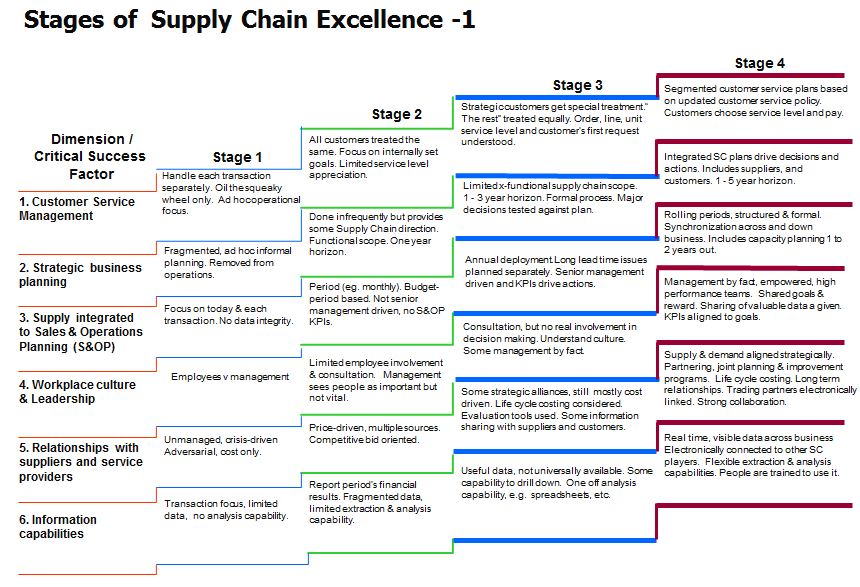
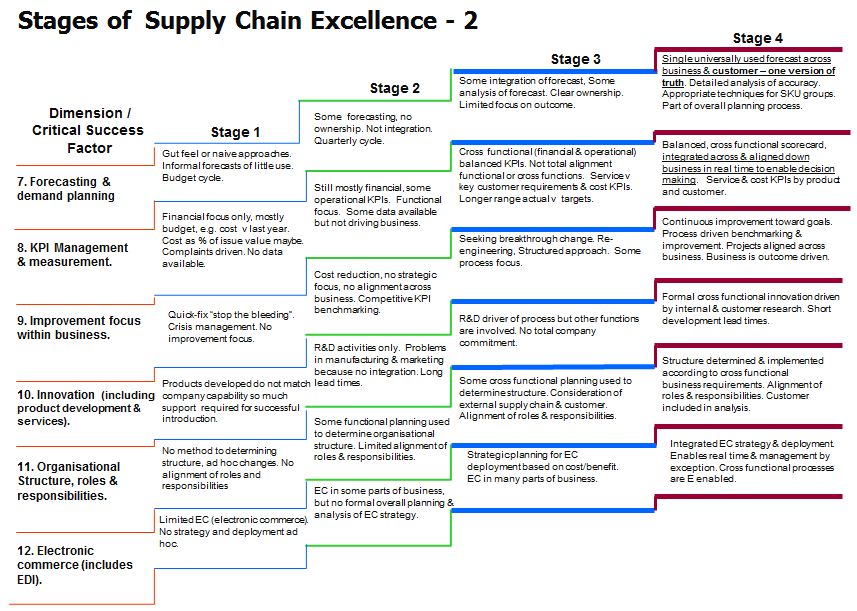
The stages of excellence chart below is provided as a starting point for group discussion with an understanding of current performance and the building of bridges between current and desired performance. For this purpose, companies are asked to:
- Highlight current stage for each dimension
- Rank dimensions (or factors critical to success) by importance (can rank importance based on overall perspective of supply chain management or from a perspective of importance to improve performance over next 12 months)
- Detail what dimension priorities are A (A = air = must have today) and then water (need next week) and food
Company improvement and future peer group discussions can be focused on building these bridges to assist organisations from moving from one stage to the next.
Using the Framework Practically
I should explain the A, water, food prioritisation, because it’s something I use a lot with clients and people sometimes find it a bit odd at first.
The idea is simple. Air is something you need right now. You can’t survive without it for more than a few minutes. These are your urgent, critical priorities. If you don’t address them immediately, bad things happen.
Water is next. You can survive a few days without it, but not much longer. These are things you need to tackle soon, probably within the next week or two.
Food is important for the long term. You can go weeks without it in an emergency, but eventually you’ll need it. These are your medium-term priorities.
When you apply this to the stages of supply chain management, it forces leadership teams to be honest about what actually matters right now versus what would be nice to have. I’ve sat in too many planning sessions where everything is a priority, which really means nothing is.
Linking to Broader Diagnostics
The other challenge is to link the stages of excellence chart with the Benchmarking Success COFS™ Diagnostic and the world class supply chain model.
This is something we’ve worked on quite a bit. The stages of supply chain management framework gives you a high-level view of maturity across different dimensions. The COFS™ Diagnostic goes deeper, providing quantitative benchmarks against peer organisations. And the world class supply chain model defines what good actually looks like at the most advanced stages.
Used together, these tools help companies understand not just where they are in the stages of supply chain management, but how they compare to others and what specific capabilities they need to develop to progress.
Getting Started
If you’re thinking about applying the stages of supply chain management framework in your own organisation, here’s my suggestion. Get your leadership team in a room, put the stages of excellence chart on a screen, and ask everyone to independently mark where they think the company sits on each dimension.
The differences in perception are usually where the interesting conversations happen. One person thinks you’re at stage three on demand planning. Another thinks you’re barely at stage one. That gap tells you something important about alignment and visibility within the business.
From there, you can start to prioritise. Which dimensions matter most? Which gaps between current and desired state are most urgent? What would it take to move from one stage to the next?
The stages of supply chain management framework isn’t meant to give you all the answers. But it’s a useful way to structure the questions.