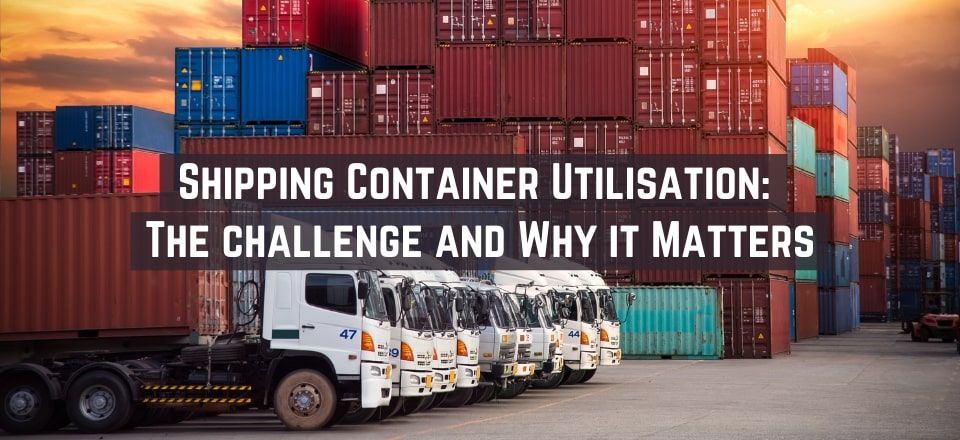
Shipping air inside expensive freight containers has never been a cost-effective approach to transportation. Today though, it’s even more critical to try and improve capacity utilisation, given the skyrocketing costs of container freight shipping.
While it may have been acceptable in the past to consider underutilised containers as an unavoidable cost of international shipping, the astronomical costs of container freight in 2021 no longer allow for such a luxury – at least, not for companies serious about maintaining realistic margins and staying in business.
I’ve been working with supply chain teams for over 30 years now, and freight container utilisation is one of those topics that tends to get a knowing nod in meetings but rarely gets the attention it deserves afterwards. Everyone agrees it matters. Few actually do the work to fix it.
Now is the time to take a long, hard look at how much container capacity your business unintentionally assigns to shipping fresh air. To that end, we hope you will find the tips in this article helpful as you look to improve container utilisation in your supply chain.
Is Container Underutilisation That Much of a Problem?
The unfortunate reality is that many companies, even those that rely on thousands of container movements annually to keep their supply chains running, are not especially aware of how much wasted space they are paying for with every shipment.
To put the issue into perspective, a study into container loads imported into the United States in 2018 found that utilised capacity was just 65%. In other words, containers were, on average, only just over half full.
That figure still surprises people when I mention it in workshops. They assume their operation is different, that surely they’re doing better than that. But when we actually measure it, most companies fall somewhere in that same range. Some are worse.
Add to that the fact that container shipping costs on some tradelanes have tripled during 2020/21, and it’s not hard to see why improving utilisation should be a primary concern for any supply chain manager with responsibility for ocean freight shipping.
Raising Freight Container Utilisation: The Size of the Prize
It is one thing to know that a 65% container utilisation rate is not good enough, but quite another to find the motivation to do something about it. As already mentioned, many companies have historically accepted that much of their shipping-container space is unfilled, so perhaps seeing the volume of wasted space quantified will do little to shake that sense of resignation.
It might be better to look for a carrot to tempt your management team into working on improved utilisation, and in fact, you don’t need to look too far to find it.
When it comes to carrots, money talks, so let’s talk about just how much money your business might save by filling up that container space with something a little more profitable than air.
It’s not realistic to expect that your company can fill containers to the 100% mark, but then, you won’t need to go that far to achieve substantial savings through utilisation improvement.
Do you annually ship containers numbering in the hundreds, or even in the thousands? If so, an increase of around 20% capacity utilisation, from 65% to 85 or 90%, will dramatically reduce the number of shipments, returning millions of dollars in saved freight fees.
The Hidden Costs of Poor Freight Container Utilisation
Before we get into the solutions, it’s worth understanding just how poor freight container utilisation affects your business beyond the obvious shipping costs.
First, there’s the environmental impact. Every container you ship that’s half empty means you’re essentially doubling your carbon footprint for those goods. With increasing pressure from customers and regulators around sustainability reporting, this isn’t something you can ignore indefinitely.
Then there’s the inventory effect. If you’re shipping more containers than necessary because each one is underutilised, you’re also likely ordering in smaller batches more frequently. That has knock-on effects for your warehouse operations, your purchasing team’s workload, and your supplier relationships.
I worked with a homewares importer a few years back who was shipping 400 containers a year at roughly 60% utilisation. When we restructured their ordering patterns and improved their load planning, they dropped to 280 containers annually. Same volume of product. Fewer shipments. Better margins.
Increasing Container Utilisation: How to Do It
Once aware of the potential cost savings to be had from utilising shipping-container space more effectively, the obvious question that follows is, “how do we do it?” So now, let’s get to the options you can explore and test for viability.
You can approach the problem from several angles. For example, you can look at:
- Your products and the way you package them for shipping.
- The size and types of shipping container you use.
- The manufacturing, ordering, and transportation processes for your goods.
- The configuration of your container loads.
You may not be able to make changes to all of these elements, but you might at least begin by asking yourself and your logistics team if possibilities exist to optimise each one in turn.
To help you gather some ideas, we’ll take a quick look now at each of the points 1 to 4 above, and how in each case, you might find it possible to improve the use of your container space.
Products and Packaging
Packaging can play an influential role in the utilisation of container capacity, and in many cases, that influence is negative, because containerisation is often omitted from packaging design considerations.
Carton dimensions, in particular, can make a critical difference between the ability to double stack pallets in a shipping container and the limitation of single stacking, which will leave a substantial amount of wasted space in the upper area of a container.
Do your container loads typically comprise single-stacked pallets? If yes, could you reduce the height of your cartons (if your products are packaged in cartons) so pallets can be double stacked and hence, occupy the upper space, as well as the floor space, of your containers?
Can packaging dimensions be altered in other ways to enable shipping containers to accommodate more of your products? These are the types of questions to ask and answer when evaluating packaging options for improved container utilisation.
Honestly, the number of times I’ve seen packaging designed without any consideration for how it fits into a container is remarkable. Marketing wants a certain box shape. Manufacturing has equipment set up for specific dimensions. Nobody thinks to ask the logistics team until the containers are already shipping half empty.
Types and Sizes of Shipping Container
In some cases, container utilization problems can have more to do with the container than the goods occupying it. For example, many companies don’t pay enough attention to appropriate container sizing when booking their international ocean freight shipments, preferring to leave those decisions entirely in the hands of their freight forwarders.
A little time and effort spent optimising the combination of containers and their loads, rather than just the latter, can yield impressive savings by increasing the amount of space utilised.
For instance, does your company always opt for 40-foot standard containers, and if so, do you often find that you can’t quite get your pallets double stacked?
Rather than shipping nearly half a container full of thin air or loose loading cartons on top of wrapped pallets, you might want to consider booking a 40-foot high cube unit instead of a standard container.
The high cube has greater capacity and is taller, which might enable you to double stack your pallets to fill almost all the container space.
Better still, the cost for shipping a high-cube container is often not much higher than that of a standard 40-foot unit. Similarly, there may be times when it’s more cost-effective to hire 20-foot containers and fill them rather than shipping partially filled 40-foot boxes.
Changing How Goods Are Manufactured, Ordered, and Shipped
When looking for ways to reduce the amount of air you ship in your ocean freight containers, it pays to think outside the box—or perhaps that should be inside the box. You see, aside from the shape and size of your cartons and how they occupy container space, you can also improve capacity utilisation by minimising the amount of airspace existing inside your packaging.
Of course, to do this, you might need to rethink some elements of manufacturing, such as switching from finished units of furniture (or other bulky items) to unassembled or partially assembled units that can be packed more tightly into a container.
The ubiquitous flat-pack lends itself admirably to container shipping. So even if sales of fully assembled items are part of your company’s unique value proposition, it might be worth exploring if you can ship the items in flat packs and have them built at their destination rather than at the point of origin.
Furniture is just one example of how a shipper might minimise the amount of space taken by air within the packaging of products. Vacuum packing, compressing, and postponement of assembly are all possibilities to consider for ensuring container space is taken up by more product and less thin air.
Load Configuration
How do you configure your loads for shipping in containers? Do you have the option to alter the configuration? How about palletisation? Did you know that it’s far easier to configure loads comprising unpalletised cargo than palletised?
Naturally, there will be a tradeoff, as your goods might need to be palletised for onward shipment at their destination port or terminal. Therefore, you’ll also need to provide printed or electronic destuffing and palletisation instructions to accompany each shipment.
You might need specialised MHE to aid stuffing and destuffing too. On the other hand, international freight sans pallets will not incur the time and cost of inspection, certification, and fumigation necessary when pallets are present. With all that taken into account, then, a cost comparison of palletised and unpalletised shipments could be helpful—depending, of course, on the volumes and types of products that you ship.
Measuring Your Freight Container Utilisation
Before you can improve something, you need to measure it. And the thing is, many companies don’t actually track their freight container utilisation in any systematic way.
Here’s a simple starting point: for your next 20 container shipments, record the actual cubic metres of product loaded versus the available cubic capacity of the container. Do the same calculation by weight if you’re shipping dense goods. The lower of the two percentages is your effective utilisation rate.
If you’re below 70%, you’ve got significant room for improvement. If you’re between 70% and 80%, there’s still opportunity but you’re not in crisis. Above 85% and you’re doing reasonably well, though there may still be gains to be found.
The key is to make this measurement ongoing, not a one-off exercise. What gets measured gets managed, as the saying goes.
There’s No Profit in Shipping Air
It’s not called full-container-load shipping (FCL) for nothing. When you use this transportation mode, you’re paying for the use of the container, and the price is the same no matter how much of the internal space you use.
Increased utilisation will reduce the shipping cost per unit for your products and reduce the number of shipments you need annually. Together that makes for significant savings, especially right now while freight rates are reaching ever greater heights.
The degree to which you can improve container utilisation will depend on whether you are the importer, the exporter, or a sales company sitting in the middle. Still, you should be able to realise some gains, and, by collaborating with the other parties in your international sales transactions, you might do better than you initially expected.
The one sure thing is that if you don’t try, then that air you’re shipping is only likely to get more costly, and you don’t make a cent from it—so why not replace it with something worth transporting?